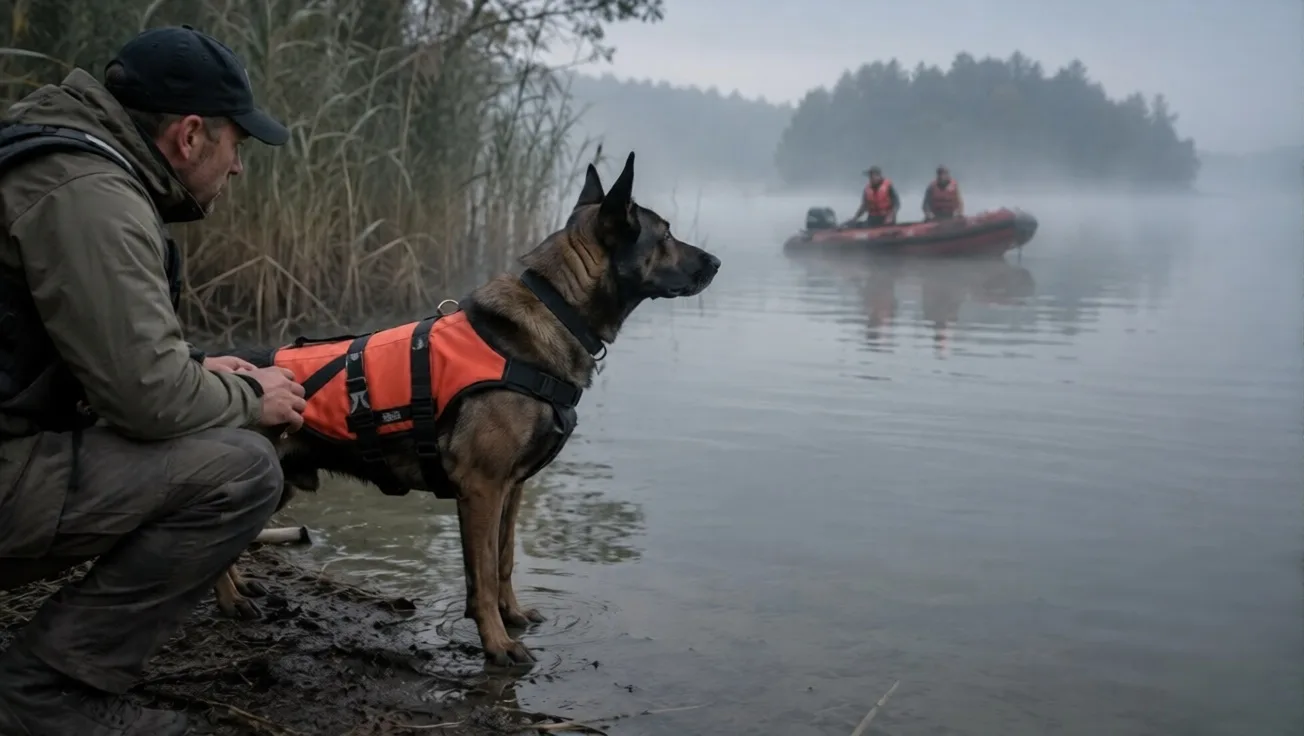
The dog approaches the car door. It draws scent from the driver’s seat. It moves off — confidently, nose to the ground. The track leads through the forest, turns between trees, then breaks at the lakeshore. The dog stops, lifts its head, samples the air over the water, and changes behavior. Now comes the question that decides everything: can the handler read what the dog has just said? Is the person here, in the water, within reach — or did he move deeper into the forest, where you must start over?
This is not a movie scene. It is the first of four scenarios you will work through in the K9 SAR/Tropienie module during CERBERUS K9.
Why Water Changes Everything
Most handlers train tracking on dry, familiar terrain. Yet the hardest real searches happen where forest meets water — and that is where the rules of the game change.
Scent over water behaves differently. Humidity changes its distribution, wind from the surface carries it in unexpected directions, reed beds create scent traps, and steep banks fracture the track. All of this distorts the picture your dog is trying to give you. The track may break at the shore and leave you with the most important question in the entire operation: did the person enter the water, or turn back into the forest? That single decision determines where you deploy resources, whether you call divers, and whether you make it in time. A mistake costs hours — and in hypothermia, hours are everything.
At CERBERUS K9, you do not train this in theory. You train on the real OSiR Piaski-Szczygliczka water area, with a WOPR team running boat-based search work, in authentic terrain with reed beds, islands, and steep banks. What is more — thanks to cooperation with WOPR Ostrów Wielkopolski, during the panel participants have access to a motorboat. This is not a desk simulation: you work with real water-rescue equipment exactly as a real operation looks. Role players are hidden where missing people actually hide — not where convenient.
Four Scenarios That Will Change How You Work
Missing angler. The dog takes the track from the vehicle, leads through the forest to the shoreline. WOPR moves onto the water. The role player waits on an island or in difficult reed cover. You learn smooth dog-handler-water-rescuer coordination.
Track analysis by the lake. Clothing and a letter by a pier. Your dog must determine direction — water or forest. This is pure track reading and decision-making under pressure, when a human life is at stake and the person may be lying unconscious a few hundred meters away.
Kayaker accident. Three people, three different locations. One reached shore and went into the forest. One is hidden in reeds. One is on the water, to be recovered by WOPR. You learn to work in chaos, where there is no single track, only multiple parallel ones.
Missing child at a campsite. The hardest emotionally. The child leaves camp along a forest road and descends to the shore. The role player is on a steep slope or in dense forest. Every second counts here — and every dog signal you cannot afford to miss.
These are not academic drills. They are replicas of situations Polish rescuers and handlers face for real — several, sometimes more than a dozen times a year.
The Secret You Will Not Learn in Your Own Backyard
Research on search teams is clear on this point: the most important link is not the dog’s nose, but the handler’s ability to read subtle changes in behavior. A missed signal is a missed person. The dog knows. The question is always whether the human understood what the dog showed. And these signals — by water, in reeds, on the forest edge — are far more numerous and far more subtle than on open, dry training grounds where most handlers spend their entire training.
You will not build this skill alone, in your own backyard. You need real terrain, real WOPR on the water, role players hidden in real hide spots, and — above all — instructors who will guide you through your mistakes here, in training, before you make them there, where human life is at stake.
CERBERUS K9 gives you all of that in one place — alongside delegations from over 15 NATO and EU countries.
The Dog Picks Up the Track. The Rest Depends on You.
Next time you see a news report about a missing person search near water, you will ask one question: would my dog and I be ready?
After two days at CERBERUS K9, the answer will be: yes.
13–14 June 2026. Ostrów Wielkopolski. OSiR Piaski-Szczygliczka. Real water area, WOPR motorboat available to participants, real scenarios.
The K9 SAR/Tropienie module costs 800 zł. In the 2025 edition, it closed as one of the modules with a waiting list. Start is in just a few days, and places are limited for water safety reasons.
The difference between searching and finding is often a few minutes and one correctly read dog signal. Learn to read it.
Book your place now - tickets.pactak9.org