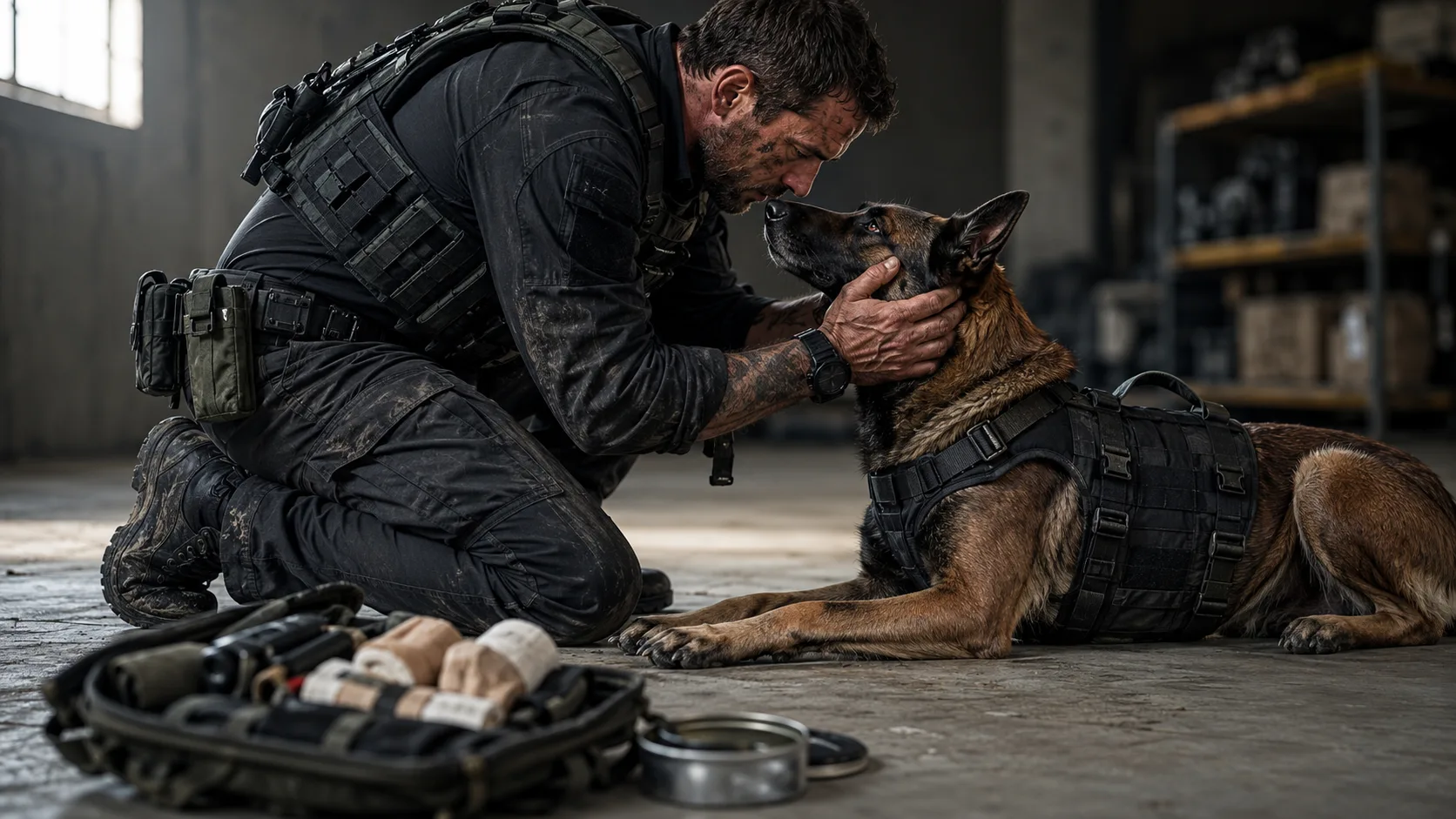
In a K9 team, the weakest link is almost never the dog.
Let me tell you something most handlers do not want to hear. Research on working dogs is surprisingly consistent on this point: it is the handler, not the dog, that is the most important factor affecting team effectiveness. The dog has a sense of smell thousands of times more sensitive than yours. It has reflexes, instinct, and readiness you cannot buy in any course. The variable that determines success or failure is you.
And it is around this uncomfortable truth that the three CERBERUS K9 2026 modules are built: K9 Detection, TCCC-K9, and Hardest Hit. Together, they answer three questions most handlers avoid.
Question one: how many of your dog's signals are you missing?
A detection dog does not fail by accident. Research on detection team performance shows that false negatives - missed odor sources - most often result from the handler failing to read a subtle change in the dog's behavior. The dog detected the scent. It gave a signal. And the human did not see it.
This is not a hypothesis. In studies, detection dog handlers indicate reading the dog's body language as the most important professional skill - above any other competence, including training itself. Moreover, it has been shown that when a handler incorrectly assumes the presence of material, their dog produces more false alerts. Your mindset transfers to the animal through the leash, posture, microscopic body tension, tone of voice. The dog reads you as well as you should read it - and often better.
The K9 Detection module - led by Lukasz "Majki" Majkut, three-time Military Gendarmerie champion in explosive detection and a veteran of two missions in Afghanistan - is not a course in teaching the dog. It is a course in teaching you how to read the dog you already have. Working material: narcotics (marijuana, amphetamine, mephedrone) and high-energy materials (saltpeter, PMW, TNT, PETN, gunpowder). "Gaps you cannot see" is not a slogan. It is a diagnosis.
Ticket: 800 PLN. Spots: 18.
Question two: when your dog has a hemorrhage, what will you do?
The dog goes where you send it. Into a corridor you have not checked. To a vehicle you do not know. It risks its life on your command - and does so without hesitation. That creates an obligation most handlers do not recognize until it is too late.
Hemorrhage is the leading preventable cause of death in service dogs. Crucially, most bleeding wounds are not fatal in the first moment. They become fatal only because of delay in controlling the hemorrhage. These are minutes. Minutes in which you either know what to do or watch helplessly.
In 2019, the Committee for Tactical Combat Casualty Care for Working Dogs (K9TCCC) was established, affiliated with the international TCCC Committee. The goal: eliminate preventable deaths of service dogs and increase their survivability in operations. The same principles - simple, battle-proven interventions - can be mastered by you, without being a veterinarian. The U.S. military trains regular handlers in this precisely because a veterinarian is never on scene in the decisive minute.
The TCCC-K9 module teaches hemorrhage control in dogs, management after penetrating trauma, and stabilization before reaching a veterinarian. This is not knowledge for veterinarians. It is knowledge for the handler who wants their dog to come home.
Included in tickets: K9 Defense, K9 Detection, K9 SAR/Tracking.
Question three: do you really know what you have?
Most handlers have never tested their dog - or themselves - under real pressure. Training on a familiar field, with familiar stimuli, gives an illusion of competence. But research on working teams shows something ruthless: differences in effectiveness between teams are enormous, and the source of success or failure almost always lies on the handler-dog pair side, not in the dog alone.
Until you expose yourself to assessment, you operate in a vacuum. You do not know where you are. You do not know what to improve. You do not even know whether what you take for success is simply the absence of a real test. Pressure reveals what a familiar field will never show.
Hardest Hit - the protection dog competition at CERBERUS K9 2026 - is a controlled but uncompromising test. The best dogs from Poland, the Czech Republic, Slovakia, and beyond. You will leave knowing where you really are - regardless of the result. And that is the starting point for any improvement.
Ticket: free. Starting spots: 19.
Three questions. One weekend. One decision.
Your dog is probably better than you think. The question CERBERUS K9 2026 puts before you is: are you its equal?
Learn to read the signals you are missing today. Learn to keep it alive when it risks everything. Check where you truly stand as a team.
13-14 June 2026. Ostrow Wielkopolski. Five locations, including a closed ORLEN industrial site. 15+ NATO and EU delegations as participants, not spectators.
K9 Detection - 18 spots. TCCC-K9 - free. Hardest Hit - 19 starting spots. These are real numbers from the registration system. In the 2025 edition, the K9 modules closed with a waiting list.
Your dog is ready to give you everything. The least you can do is be worthy of it.
The decision is now. tickets.pactak9.org