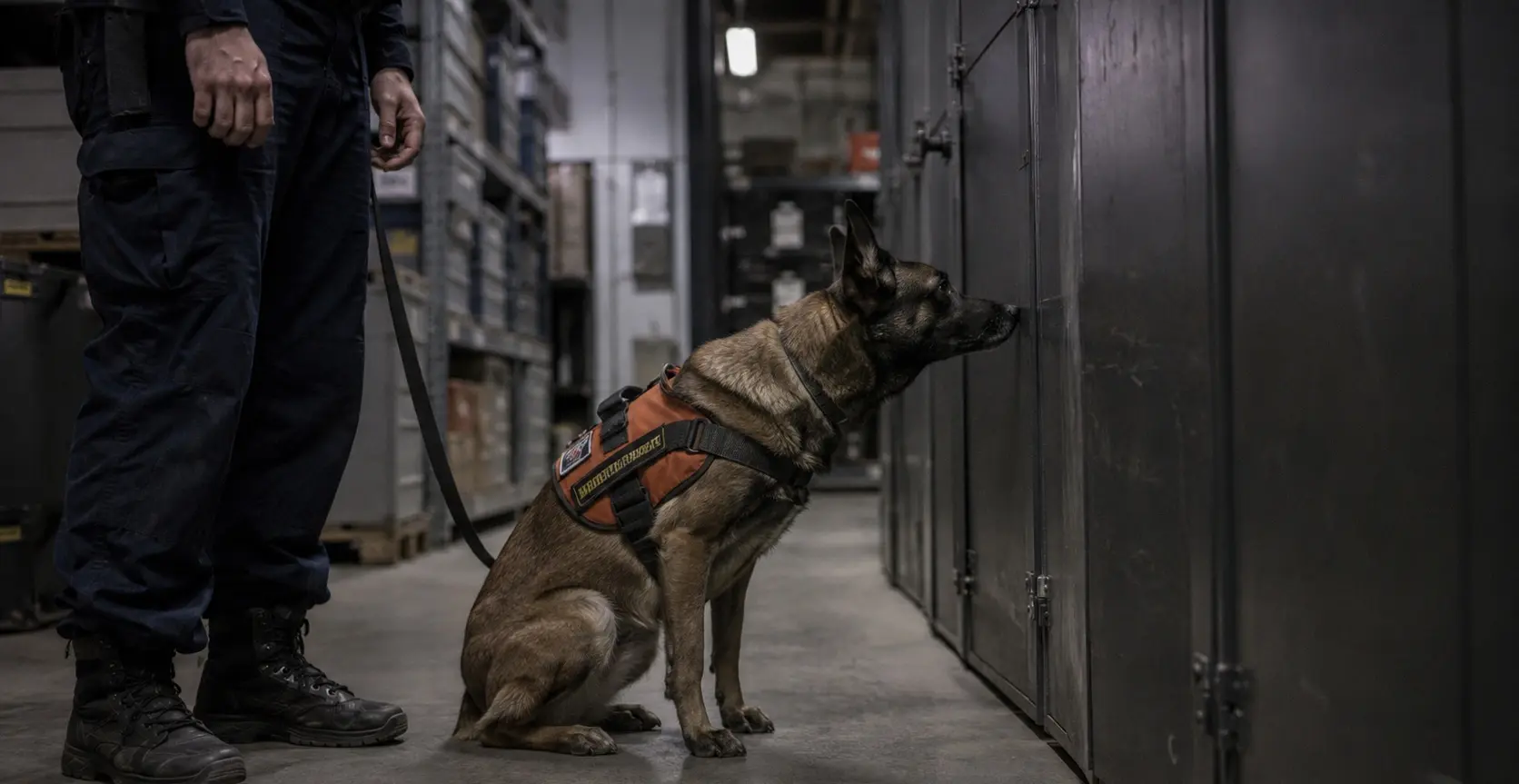
A false alert is not the dog's fault. It is the fault of a training system that, over weeks, months, sometimes years — taught the animal the wrong patterns. It rewarded at the wrong moment, introduced scent under the wrong conditions, built associations that cannot be rewritten later. The problem is that most handlers notice this mistake too late. Or not at all — because on the training ground the dog still performs correctly.
Łukasz „Majki" Majkut, former operator of the Special Operations Division of the Special Unit of the Military Gendarmerie, three-time champion of the Polish Armed Forces in explosive scent detection, veteran of two tours in Afghanistan — has seen this dozens of times. A dog that performs flawlessly on the training ground falls apart in a real environment. Not because it is a bad dog. Because nobody taught it to work the way real detection demands.
At CERBERUS K9 2026, he will lead a panel that changes that.
This Is Not Ordinary Training
The K9 Detection panel consists of seven programme blocks building a complete methodology for detection dog work. The working material covers two areas that are rarely combined in a single training course in Poland.
Narcotics: marijuana, amphetamine, and mephedrone — substances critical for police K9 teams, customs service, and border protection.
High-energy materials: saltpeter, PMW, TNT, PETN, and powder — these are the scents on which Majkut earned his three Military Gendarmerie championship titles. The environment he knows from Afghanistan. A competency that no one can pass on who has not mastered it operationally themselves.
Combining both groups in a single panel is the answer to the real needs of the services — from the Police, through the Border Guard, to critical infrastructure protection.
But every serious detection error starts at the foundations.
Motivation and concentration is the first block — and not by coincidence. A dog without drive to work will never become a reliable detection tool. Majkut has worked with dogs since 2008 and knows that drive can be built — but only when you understand the mechanisms that govern it. Most handlers take shortcuts. The effects appear one or two years later — the dog works at half its potential.
Scent imprinting — fast, effective, and clear to the dog — is the second foundation. A bad imprint is difficult to correct. A proper one opens the door to reliable scent work. Majkut will show how to do it right the first time.
Where Most Trainings End — This One Begins
Passive source indication divides detection dogs into two categories: those you can trust — and those you should not. A dog that indicates loudly and actively disqualifies itself in many environments. Airport, crowd, vehicle with occupants — there, precision is needed, not spectacle.
Handler technique is the fourth block — the most difficult to correct on your own. Leash, slack, timing of reward, reading body language: these elements create a feedback loop that either reinforces correct behaviours or systematically destroys them.
Search systematics — straight lines, open terrain, rooms, luggage, vehicles — is the fifth block. Every environment is governed by different laws of airflow and scent distribution. A handler who does not understand the search tactics for a specific area is counting on luck.
The sixth block — real-time error analysis — is something most trainings do not address. False alerts, loss of motivation, desensitisation — Majkut has worked through these problems on his own dogs, before competitions at the European level. He knows where they come from and how to eliminate them.
The seventh block — training planning and staging — concludes the programme with a logical structure that every participant takes home. Not inspiration, not "motivation to keep going". A concrete plan: how to raise criteria, how to design sessions, how to measure progress.
Who Leads
Łukasz „Majki" Majkut is not a trainer who learned from someone who learned from someone. He is a person who for years worked in one of the toughest K9 structures in Poland — the Special Operations Division of the Special Unit of the Military Gendarmerie — as a certified handler of one of the first combat dogs in the Polish Armed Forces. Certified decoy levels I and II. Two-time veteran of missions in Afghanistan.
Three-time champion of the Military Gendarmerie in explosive material scent detection: 2018, 2021, 2023. Two-time runner-up: 2016 and 2022. Podium in Slovakia. Competition start in Belgium. Titles earned on the same substance list you will be working with in the panel — TNT, PETN, saltpeter, powder. Not theory. Not simulation. Years of competition-verified practice.
Today he leads the KMS K9 Group in Warsaw — a school training dogs, handlers, decoys, and service K9 trainers. He teaches the precision he himself learned where a mistake costs more than a lowered score on an exam.
If you want to know what detection looks like at the operational level — he knows it from experience, not from a book.
16 Spots Remaining
The K9 Detection panel at CERBERUS K9 2026 is 800 złotych — two days of intensive work with the full spectrum of detection substances: narcotics (marijuana, amphetamine, mephedrone) and high-energy materials (saltpeter, PMW, TNT, PETN, powder). A real operational environment across five locations, including a closed industrial site. An instructor with championship titles on those exact substances.
There is no other way to acquire this level of knowledge in two days. Private training with Majkut means weeks of waiting and many times the price.
There are sixteen spots. In previous editions, detection modules filled first — and always left a waiting list.
tickets.pactak9.org | June 13–14, 2026 | Ostrów Wielkopolski