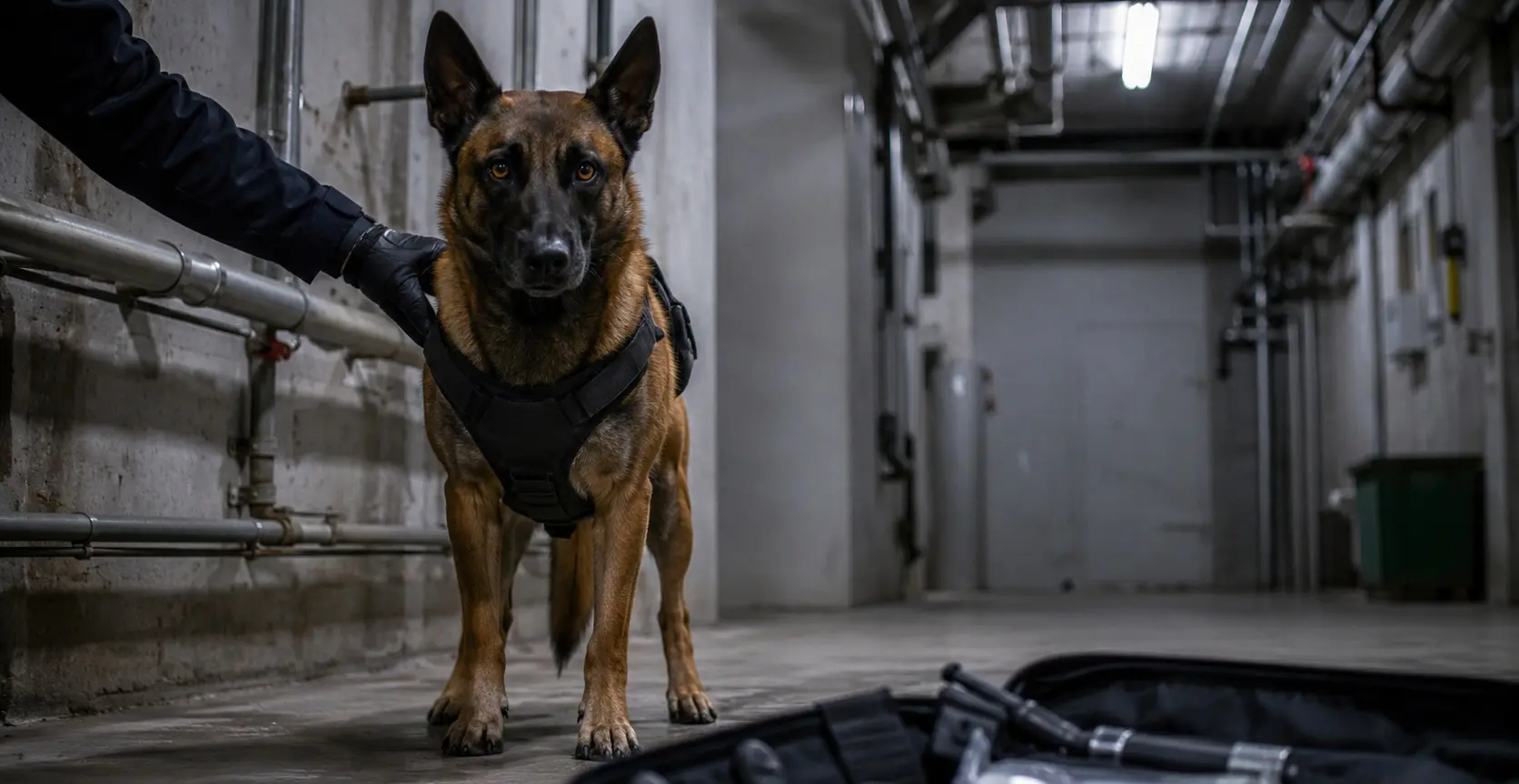
Poland maintains over a thousand service dogs in uniformed formations — 834 in the Police, 190 in the Border Guard, plus dozens more in PSP and SOP. The United States fields fewer than 550 dogs across the entire Military Working Dog (MWD) programme — globally, across all theatres of operations. That imbalance should give pause: the question is not how many dogs we have. The question is how they are trained.
Stress as the Only Credible Examination
Standard certifications for service dogs in European formations verify animal behaviour under controlled conditions — on familiar surfaces, with familiar stimuli, with a handler the dog has known for months. That approach has pedagogical value, but limited tactical value.
A study published in a peer-reviewed journal and indexed in PubMed, analysing US Army service dog behaviour during standardised stress tests, found that 83.87% of the animals studied showed at least one behaviour indicating aggression under environmental provocation. That does not mean they were unfit for service — it means that under stress, dog behaviour diverges from training assumptions in ways that must be recognised, managed, and factored into operational planning.
The US Army MWD programme verifies dogs not on a passed examination, but on documented work in conditions close to mission reality. Programme recruits are predominantly Belgian Malinois — selected for work intensity and behavioural flexibility. But even the best genetically matched dog is a non-operational tool if training omits the environments where it will actually work: enclosed industrial spaces, night operations, crowds.
Poland lacks a unified service-dog certification standard across formations. Police, Border Guard, military — each institution operates under its own protocols, which are not aligned with NATO Military Police K9 Working Group guidelines. That is a systemic gap, not a personal one. Polish handlers are highly qualified professionals working within a system that has not kept pace with the evolution of threats.
TCCC: The Doctrine That Changed Survival Statistics
Tactical Combat Casualty Care — tactical care for the wounded under combat conditions — is a medical protocol developed from analyses of causes of death on battlefields from the 1990s onward. Its logic is uncompromising: most preventable deaths result from external haemorrhage. If every soldier in the element can stop bleeding before a medic arrives, survival rates rise in ways no reorganisation of medical evacuation can match.
A peer-reviewed overview published in PubMed states plainly that TCCC delivered "unprecedented decreases in preventable combat death" in units where training reached every soldier, not only medical personnel. The critical detail: the benefit appears when, and only when, the skill is universal — not reserved for a specialised few.
The Polish Armed Forces conduct TCCC training aligned with current Committee for Tactical Combat Casualty Care standards — a correct step. The problem lies outside military structures: among civilian-service K9 operators, municipal guard officers, and critical-infrastructure security staff. No publicly available Ministry of Interior or Ministry of National Defence document describes a mandatory TCCC programme for that occupational group.
A service-dog handler who cannot stop haemorrhage in a human or a dog is an operator with a competency gap that cannot be accepted in a high-risk environment.
TCCC-K9 protocols — field tactical veterinary care developed by the US Army — include, among other things, application of a pressure band on a dog's limb, management after penetrating chest trauma, and basic stabilisation before transport. The US Army states explicitly that MWD dogs operate in high-risk scenarios and that health and operational-readiness programmes are actively developed to increase their survivability in operations. In Poland, that knowledge remains largely in informal circulation.
NATO, Resilience, and the Civilian Role in Security Architecture
The 2016 NATO Summit in Warsaw produced the Commitment to Enhance Resilience — a pledge to build resilience across the full spectrum of threats, including hybrid threats, with seven baseline national resilience requirements. In 2021 the Alliance reinforced the commitment, extending it to conventional, unconventional, and hybrid threats. NATO ACT defines resilience as the ability to "prepare, resist, respond, and rapidly restore normal conditions after strategic shocks".
Russia's invasion of Ukraine in February 2022 turned those declarations into an urgent operational necessity for the Alliance's eastern flank. Poland, bordering Ukraine and Belarus, faces a challenge that is not exclusively military. Societal resilience means, in practice, millions of citizens who know what to do — and hundreds of thousands of K9 operators, rescuers, and officers who operate at the interface between armed forces and civil society.
That category — the professional security sector outside the military — is the largest gap in the system. TCCC training, K9 certifications to operational standards, drone recognition as a universal skill: NATO openly acknowledges that pressure to expand such competencies has risen sharply since 2022, because modern conflicts have made small unmanned aerial systems a tactical tool at every level, not only in specialised units.
Operational Conclusions: What Must Change
Initiatives such as CERBERUS K9 — a training platform bringing together K9 and TCCC delegations from more than fifteen NATO and EU countries — show that the competency gap does not have to wait for institutional reform. Methodology exchange between US Army instructors, Portuguese Navy special units, and Polish K9 operators creates knowledge transfer that, in bureaucratic reality, takes years.
The conclusions are concrete. First: service-dog certification in Poland requires alignment with NATO protocols and expansion to include mandatory tests in stress environments — industrial, night-time, multi-stimulus. Second: TCCC should become a standard requirement for every K9 operator, Border Guard officer, and critical-infrastructure security employee — not as optional training, but as a condition of admission to duty. Third: TCCC-K9 knowledge must move beyond informal networks into official training programmes for civilian services.
An operational dog without a properly trained handler is a tool below its potential. A handler without medical competencies is a link that may not survive the event they were meant to prevent. Poland has over a thousand service dogs. It is time to ask aloud how many of them are truly ready.
Article prepared on the basis of: NATO Commitment to Enhance Resilience (2016); NATO ACT, Resilience in NATO; US Army / AUSA, Military Working Dog Program statistics (2024); PubMed, systematic review of TCCC and preventable death prevention; Military working dog behavioural stress study (PMC); Polish Armed Forces TCCC programme documentation; Police/Border Guard data via PAP/Polish Radio (2020); Central European Institute, regional security assessment post-2022.