Routinization. The Silent Killer of Combat Effectiveness
The training ground is a controlled environment. Known entry, known scent, known scenario. A decoy the dog has seen dozens of times. Grass mowed to the same centimetre. A command always followed by reward.
The dog learns this system. Efficiently. Effectively. And that is exactly what destroys it.
A dog's brain, like a human's, seeks patterns. When the environment is predictable, the animal optimizes its response to a specific schema — not to variability. That adaptation wins in sport. In the real world — it kills utility.
Routinization means the dog stops reacting to a stimulus and starts replaying a sequence. The difference is fundamental. When the scenario breaks the pattern — different direction, different sound, different movement dynamics — the dog's nervous system gets one message: unknown. And there is no learned response to unknown.
The result? Freeze. Hesitation. Scanning for threats instead of offense. The dog that was confident on the training ground becomes cautious to the point of uselessness on the street.
Example from US Army documentation: a dog named Anka, after her first combat exposure in real noise and smoke, became distinctly "hesitant" — wavering, less decisive, tactically degraded. Not because she was a weak dog. Because nobody had built resilience to chaos in her.
CQB. An Environment That Does Not Ask About Your Plan
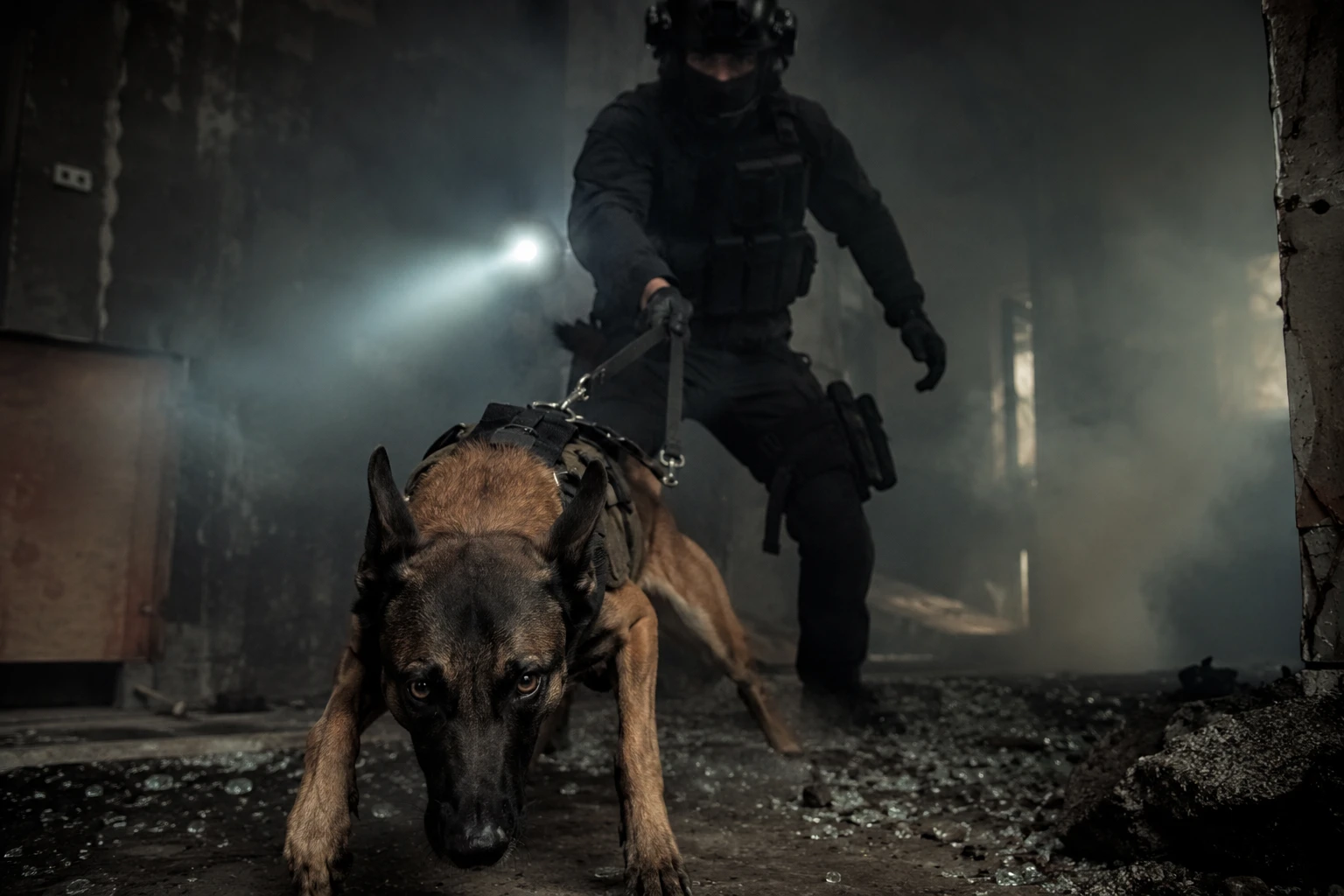
Close Quarters Battle is not a dramatic label for effect. It describes the physical reality in which the dog must work: tight corridors, minimal lighting or none at all, work with a flashlight creating shadows and disorientation, movement of multiple people in different directions, smoke, gunfire or other percussive stimuli, shouting, intense odours.
In this environment sensory overload occurs. This is not hyperbole — it is a concrete neurophysiological mechanism in which the volume of stimuli exceeds the nervous system's ability to prioritise them. The dog does not filter threats by priority. It starts reacting to everything — or to nothing.
Research on dogs working in counter-terrorism units confirms: resilience to combat stimuli is built only through systematic, controlled exposure — noise, smoke, movement, multi-stimulus input, unpredictability of human behaviour. There is no shortcut. There is no substitute.
Darkness is not merely the absence of light. It deprives the dog of its secondary orientation system — vision — while amplifying smell and hearing, which receive conflicting signals in chaos. A dog working in CQB must have a nervous system that does not collapse under stimulus pressure. The training ground will not teach that. You cannot buy it.
Your Stress. Its Failure.
Here we come to an element most civilian handlers ignore or downplay. Your psychophysical state is a direct regulator of your dog's combat readiness.
The mechanism is precise and documented.
The dog detects your stress through several parallel channels:
- Volatile chemical compounds — sweat and other secretions under stress have a different chemical profile; the dog senses that at distance
- Micro-tension in posture — body stiffening, shift in centre of gravity, small, uncoordinated movements
- Breathing — shallow, fast, irregular; the dog registers and interprets that pattern
- Pace and consistency of handling — every waver in leash handling or non-verbal communication is a signal: something is wrong
A study published in 2024 in Scientific Reports showed clearly: the scent of a stressed human alone made dogs less likely to choose the safe interpretation of a stimulus and learn cognitive tasks differently. In plain terms — your cortisol changes how your dog thinks.
Cortisol works differently from adrenaline. Adrenaline is a short alarm impulse. Cortisol is a prolonged mobilisation state — it rises more slowly but maintains tension for a long time. When you enter a scenario with elevated cortisol, your dog synchronises with that state. The effect: heightened defensive alertness, narrowed attention, weakened offensive initiative.
Published analyses state plainly that stress in dogs is linked to poorer concentration, greater anxiety, and decline in cognitive function. A combat dog in a state of elevated cortisol is not a combat dog. It is a reactive dog — and not always in the direction you need.
The handler can be the greatest amplifier of confidence or the greatest saboteur of the operation. If you enter a task chaotically, your dog gets a non-verbal message: this scenario is out of control. That lowers its initiative and raises defensive alertness. Exactly the opposite of what you need.
That is why during realistic shooting exercises in the US Army, the operator deliberately calmed the dog with voice and touch at moments of agitation. That was not a gesture of empathy. It was active stabilisation of the nervous system, part of the tactical protocol.
Tacticool. An 800-Złoty Harness Will Not Teach a Dog to Think
The tactical K9 market has exploded. Ballistic vests, Cobra harnesses, MOLLE collars, rail-mounted lights. The industry packages it beautifully — protection, control, ergonomics.
None of it builds mental resilience.
Gear carries the dog; it is not its operational system. A dog in a two-thousand-złoty vest that has never worked in darkness, smoke, intense noise, with a handler under stress — is impressive visually and fragile functionally.
Industry articles on tactical K9 accessories emphasise protection from injury and environmental conditions — not a word about stress response, behavioural resilience, combat habituation. Because gear does not solve that.
Buy the gear? Fine. But do not confuse equipment with readiness.
CERBERUS K9. A Test, Not a Seminar
The CERBERUS K9 initiative was born from one diagnosis: most dogs in Poland have never been truly tested.
This is not another seminar with a certificate and coffee after training. This is an industrial environment — darkness, noise, smoke, a decoy breaking the pattern. Conditions where the training ground stops mattering and only what you have actually built in the dog and in yourself remains.
No concessions. No pretence.
If your dog is ready — come and prove it. If you are not sure — come and find out what you really need to fix.
The truth about your dog waits in the darkness.
Material prepared on the basis of US Army Military Working Dog Training analyses, IWDBA research, and data from peer-reviewed scientific publications (Scientific Reports 2024, PubMed).